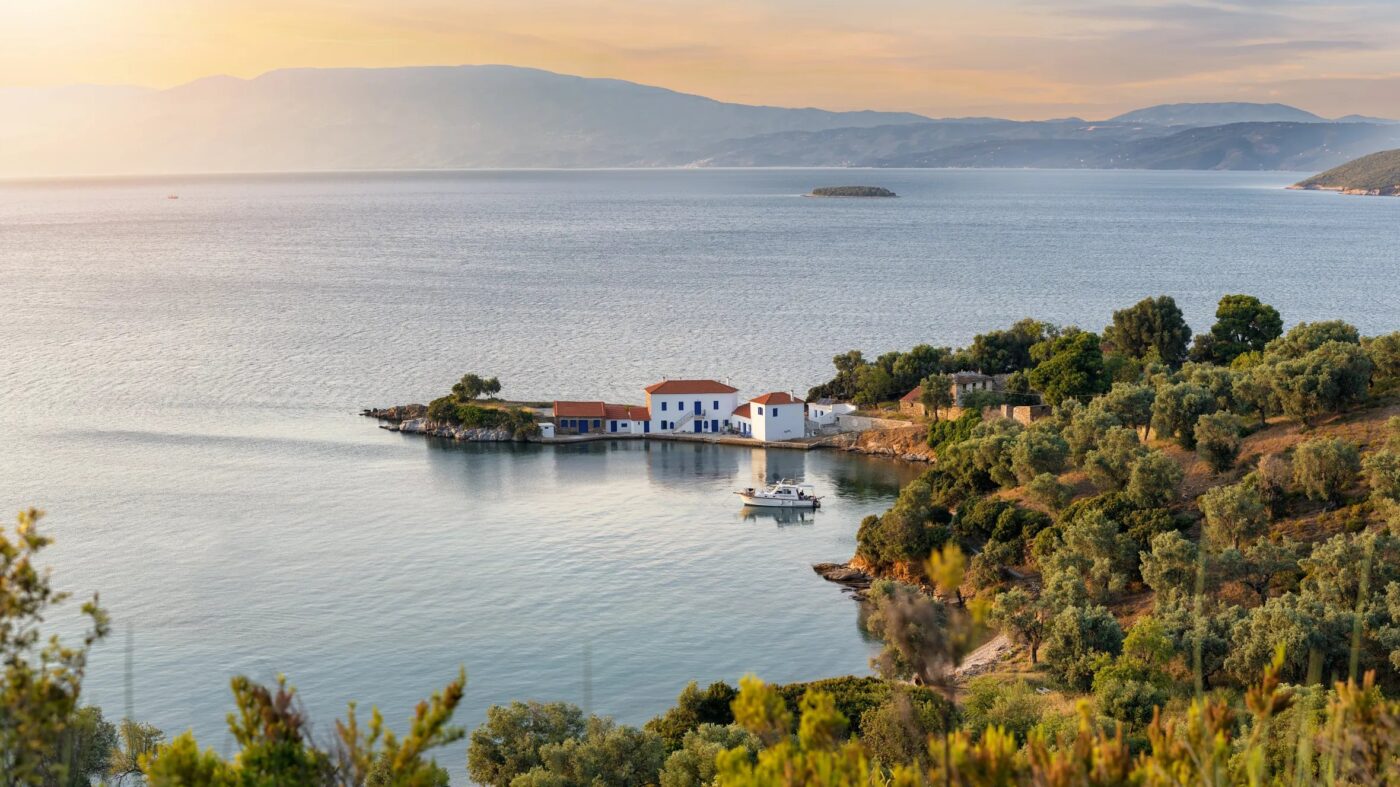
Stone villages clinging to mountain slopes, plane trees in every square, narrow lanes that drop suddenly to a beach the colour of glass. Pelion is the part of mainland Greece the international platforms don’t cover — and locals would rather you didn’t ask. We have five villas there, and a small share of guests who keep coming back. This is what makes it different.
This guide covers what makes Pelion unlike anywhere else in Greece, when to go, what to do across two very different sub-regions, and our five hand-picked villas in the area.
Why Pelion
Pelion is a peninsula on the Aegean side of mainland Greece — the green, mountainous one that arcs out from the port city of Volos and curls south toward the Sporades. Mythology says the centaurs lived here, and looking at the sheer slopes covered in chestnut and plane forest, it’s not hard to see why. There are no ferries to plan around. There’s no airport on the peninsula itself. The international villa platforms don’t have Pelion pages at all. It’s mainland Greece’s quietly-kept secret.
What makes Pelion different is the geography. The mountain rises to 1,624 metres in less than ten kilometres from the coast — so within a single day you can wake in a stone village at 600 m, hike a forest path to a waterfall, and swim in the Aegean before lunch. The east coast is one beautiful beach after another, walled in by mountain. The west coast looks across the Pagasetic Gulf to the mainland and gets the calmest sea in the region.
The villages are the other thing. Pelion has more than twenty traditional ones, most still inhabited, all built in slate-and-timber stone-house style. Portaria, Makrinitsa, Tsagarada, Mouresi, Milies, Vyzitsa — each has its own square, its own taverna, its own story. Several were used as filming locations for Mamma Mia! (the Skopelos sequences were partly shot at Damouchari on the Pelion coast). Locals will mention this once and never again.
When to go
The Pelion season runs late April to mid-October for sea-and-village holidays, with a separate winter season for snow.
May and June are the freshest months — wildflowers in the mountain meadows, the sea has warmed enough to swim by late May, the village squares belong to slow-moving locals and the occasional Athenian on a long weekend. Daytime temperatures sit at 22–27 °C; evenings up at altitude still call for a layer.
July and August are peak. The mainland coast can climb past 33 °C, but Pelion’s elevation buys you several degrees of cooling — Portaria at 600 m sits 5–7 °C below the coast. Beaches at Agios Ioannis, Damouchari and Plaka fill up at midday; pick mornings or late afternoons. Book early.
September and October are arguably the peninsula’s finest weeks. The sea is at its warmest of the year, the chestnut harvest is on (Pelion is one of the chestnut-producing centres of Greece), and the international visitors thin out. Days are long enough for a coastal swim followed by a village dinner under the plane trees.
November to April brings the second season. The Agriolefkes ski centre above Portaria is one of the closest-to-Athens ski areas; the Pelion mountain villages turn into stone-and-log-fire winter retreats. Most beach-side properties close, but mountain-side ones stay open year-round.
What to do, by sub-region
The villas we keep in Pelion sit in two distinct parts of the peninsula. They give very different holidays.
Agios Ioannis and the East Coast
This is the postcard Pelion: a string of beaches along the Aegean side, each one tucked into a crescent of mountain. Agios Ioannis itself has a long shingle-and-fine-pebble beach with a few tavernas at the back and a narrow road behind that winds up to the village of Mouresi in five minutes. The water is unusually clear here — the seabed drops away quickly, which keeps the fine-sediment swirl down.
The other beaches within a fifteen-minute drive each have their own character. Damouchari is the prettiest — a small fishing-boat harbour with stone houses around it, used as the village square in Mamma Mia!. Plaka is wider and family-friendly. Papa Nero is shingle, popular with locals for its taverna. Mylopotamos and Fakistra are the dramatic ones, accessed down steep paths from the village above, both with formations that have appeared on the cover of every Greek travel magazine at some point.
Inland, Tsagarada is the village above this stretch of coast — a 1,000-year-old plane tree in the main square, four small chapels and an old British boarding school that’s now a hotel. The road between Tsagarada and Mouresi connects you to most of the east-coast beaches.
Portaria and the Volos Slopes
A different Pelion altogether. Portaria sits at 600 metres on the western slope of the mountain, looking down on Volos and the Pagasetic Gulf. The village square is built around a long stone fountain; the houses are mostly traditional Pelion stone-and-slate. It’s a fifteen-minute drive down to Volos for a coffee, the Archaeological Museum, or what locals consider the best gyros in Greece.
A few minutes’ uphill from Portaria sits Makrinitsa, a UNESCO-recognised traditional settlement clinging vertically to the slope. The view from its main square — across the gulf to Volos, with the boats laid out in formation — is one of the most photographed in mainland Greece.
The Moutzouris steam train still runs in summer from Ano Lechonia (just outside Volos) up to Milies, a 90-minute ride through forest and across stone bridges. It’s a survival from the 1903 narrow-gauge railway, and probably the most charming way in Europe to spend a Sunday morning.
In winter, Portaria becomes the base for the Agriolefkes ski centre (15 minutes uphill); in shoulder seasons, the Centaurs’ Path waymarked walks start from villages like Tsagarada, Milies and Portaria itself.
Where to stay — our hand-picked villas
Five villas across two sub-regions, each chosen for a particular kind of Pelion stay.
Agios Ioannis area
Villa Azalea — a contemporary stone-and-glass villa a short walk from Agios Ioannis beach. Pool, sea view, walking distance to the beach tavernas. The east-coast pick for couples and small families.
Villa Kamelia — sister property to Azalea on the same slope above Agios Ioannis. Stone-built, pool, sea-view terraces, a few minutes’ walk to the beach. Works equally well for a long stay or a fortnight.
Villa Manolia — the third house in the Agios Ioannis cluster, with a slightly more private pool deck and a kitchen-living space built around the view.
The PelionBNB cluster — Azalea, Kamelia and Manolia can also be rented together as one combined estate sleeping up to 17 guests. The natural choice for a family reunion, milestone birthday or small group reunion that wants the full slope to itself.
Portaria
Artistic House — a traditional Portaria stone house with a walled garden, fireplace, and views across to the Pagasetic Gulf. The mountain villa for travellers who want stone-and-slate Pelion rather than beach-and-pool — and the right base if you’re combining the peninsula with Volos, Makrinitsa, or a winter ski week at Agriolefkes.
If you’d like a hand matching dates, group size, and the kind of holiday you have in mind to the right villa, send us your dates and we’ll come back with two or three options that fit.
Practical: Pelion, need to know
| Nearest airports | Athens (ATH, 4 hr drive) or Volos / Nea Anchialos (VOL, 30 min drive — limited summer flights) |
| Drive from Athens | 4 hr to Volos / Portaria; 4.5 hr to Agios Ioannis (across the peninsula) |
| Skopelos by ferry | 1.5 hr from Volos or Agios Konstantinos (good for a 2–3 night side-trip) |
| Best months | May–June, September–October (peak July–August) |
| Car needed | Yes — the peninsula’s distances are short but the roads are mountain switchbacks |
| Currency | Euro (€) |
| Language | Greek; English widely spoken in tourism |
| Time zone | EET (UTC+2 / UTC+3 in summer) |
FAQ
When is the best time to visit Pelion?
Late May to late June and the whole of September are Pelion’s quietest, most pleasant weeks: the sea is swimmable, the villages still belong to locals, and the temperature in the mountain villages stays in the comfortable mid-20s °C even when the coast is hotter. July and August are warmest and busiest; the Agriolefkes ski centre runs December–March for a different season altogether.
Do you need a car in Pelion?
Yes. The peninsula’s roads are mountain switchbacks linking villages and beaches, and there’s no useful public transport between them. From Agios Ioannis it’s a 15-minute drive to Damouchari, 20 to Tsagarada, 50 to Portaria via the mountain road. Volos has a small airport (VOL) for the rare direct summer charter; otherwise Athens (ATH) is the realistic arrival airport, 4 hours by motorway.
Is Pelion family-friendly?
Yes — arguably more so than the islands. Beaches are calm and shallow on the east coast (Plaka and Papa Nero are the easiest), distances are short, and the mountain villages give a different kind of day out when the children have had enough sea. The PelionBNB combined-rental option (Azalea + Kamelia + Manolia together) is purpose-built for multi-generation family stays of up to 17 guests on a single slope.
What’s the difference between Pelion and the islands for a luxury villa holiday?
Pelion gives you mainland-Greek depth — mountain villages, real working towns, longer driving distances, no ferries — alongside Aegean beaches that rival the islands. It’s quieter, less internationally known, less photographed in tourism brochures. Travellers who want the postcard Greek-island experience should head to the Cyclades; travellers who want a quiet, slow, locally-textured Greek holiday with both mountain and sea will find Pelion the better choice.
Looking at another region of Greece? Read our guides to the Peloponnese & Spetses and the Cyclades, or browse all hand-picked villas across Greece. The Attica, Evia & Chalkida guide is coming soon.
