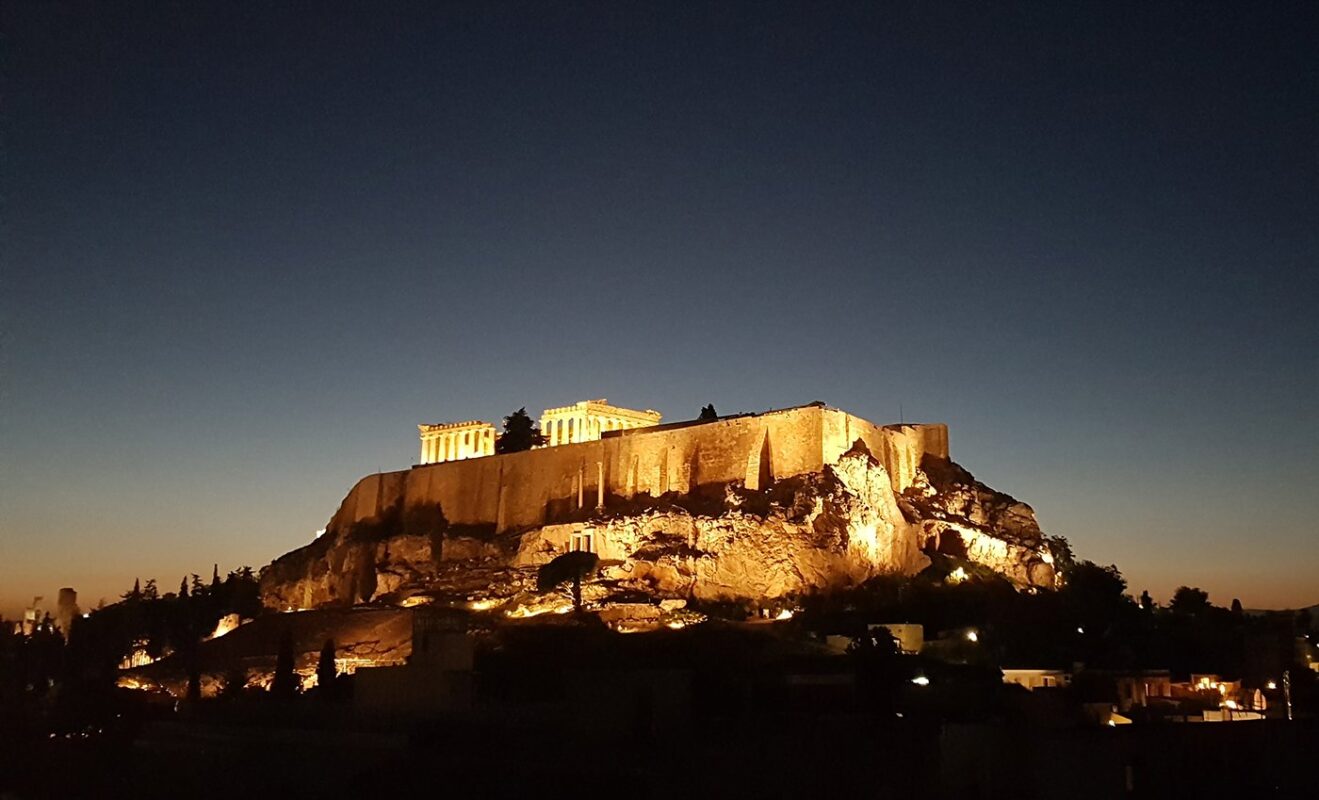
Plaka rooftops in the late-afternoon light with the Acropolis behind them. The Euripus bridge to Evia, where the current changes direction four times an hour. A quiet Boeotian bay where the only sound at sunset is the cicadas slowing down. The region around Athens is the part of Greece travellers usually skip on the way to somewhere else — and that’s a mistake. We have four hand-picked stays here, and they’re the right answer for anyone who wants a Greek holiday without a long drive or a ferry.
This guide covers what makes the region different, when to go, and our four stays across Athens, the Boeotian coast and Evia.
Why Attiki, Evia & Chalkida
The region around Athens is the part of Greece every long-haul traveller passes through and almost no-one stays in. Most international visitors land at Athens International (ATH), spend a night in the city, then head off to the islands or the Peloponnese. They miss the part of Greece that locals use as their own weekend escape: the Boeotian coast just north of Athens, and the long quiet island of Evia connected to the mainland by a single 50-metre bridge.
The geography ties three different kinds of holiday together. Attica is the city itself — Athens, with its 3,000 years of layered history, plus the Athenian Riviera coast running south to Cape Sounio. Skroponeria sits about an hour and a half north on the Boeotian coast, in a sheltered bay surrounded by olive groves. Evia is the second-largest Greek island, but reached over a bridge from Chalkida in fifteen minutes — no ferry, no flight. Locals have always known this; international platforms have largely ignored it.
What ties the three together is proximity to Athens. From the airport, you can be at Skroponeria in 90 minutes, on Evia in 80, in central Athens in 30. That makes this region the natural answer for travellers who don’t have a week to spare, who want to combine a Greek-island feel with a city leg, or who are adding a few days at the start or end of a longer trip.
When to go
The region’s seasonality splits in two.
Athens is genuinely year-round. The summer is hot — expect 35 °C in July and August — but the city’s life moves to rooftops, the museums and the metro stay air-conditioned, and the evenings cool down. Spring (March–May) and autumn (September–November) are the city’s finest seasons: olive blossom on the slopes of Lycabettus, the Acropolis quieter, the open-air cinemas just opening or closing for the year. Winter is mild and wet but the city stays open.
Skroponeria and Evia follow the typical Aegean pattern. May to October is the swimming and outdoor season. July and August are peak; coastal villages fill with Athenians on weekends but stay quieter than the international islands during the week. September and early October are arguably the strongest weeks for both — warm sea, light wind, and the produce harvest in full swing on the Boeotian and Evian inland.
Three different ways to spend a few days near Athens
The four stays we keep here cover three distinct experiences. Each one is the right answer for a different kind of trip.
Athens itself — Plaka and Kolonaki
We have two city stays in Athens, both in central walkable neighbourhoods.
Plaka is the historic old town under the Acropolis — pedestrian streets, traditional houses with bougainvillea over the doorways, ancient ruins surfacing in restaurant courtyards. The walk from a Plaka stay to the Acropolis entrance is fifteen minutes; to the Plaka tavernas, two minutes; to the metro that takes you to the airport, ten minutes.
Kolonaki is Athens’s polished residential and shopping district, on the slope of Lycabettus Hill just east of Syntagma Square. Tree-lined avenues, the country’s best espresso bars, the auction-house galleries, and the funicular up Lycabettus for the best Athenian view at sunset. It’s quieter than Plaka and has the city’s most concentrated stretch of independent restaurants.
For a long-haul traveller arriving at ATH and wanting a real Athens base for two or three nights, either neighbourhood is the answer.
Skroponeria — the quiet Boeotian coast
A 90-minute drive north from Athens airport, Skroponeria sits at the head of a sheltered bay on the Boeotian coast, looking across the South Euboean Gulf to Evia. The area is largely undeveloped — olive groves, a small fishing community, a few tavernas at the waterfront, and the kind of swimming-from-the-rocks coastline that Greeks pass down quietly.
Within a short drive sit two of central Greece’s most-visited but easy-to-get-to attractions: Delphi, two hours west on the slope of Mount Parnassus, with the most dramatically-located ancient site in Greece; and Thermopylae, half an hour north, where 300 Spartans held off the Persian army.
This is the part of Greece for travellers who want quiet, real-Greek-village character without the drive to the Peloponnese or the ferry to the islands.
Evia — an island without the ferry
Greece’s second-largest island after Crete, Evia runs along the east coast of the mainland for 180 kilometres, separated from it by a narrow strait. At its midpoint sits Chalkida, the island’s capital, connected to mainland Boeotia by an unassuming 50-metre bridge that nobody who arrives on the island remembers crossing. Below the bridge runs the Euripus Strait, famous for its tidal current that reverses direction up to 14 times a day — a phenomenon that puzzled Aristotle and still does.
North of Chalkida, the island opens into pine forests, hot springs at Edipsos, and quieter beaches at Pefki and Rovies. South sits Karystos, with one of the longest sand beaches in Greece. Inland, Steni and Limni are the kind of mountain-and-sea villages travellers expect to find in the Cyclades but never do.
The island has all the relaxed-Greek-island feel without any of the ferry timetable. From Athens airport you’re at Chalkida in 80 minutes by car. From there, anywhere on the island is two hours or less.
Where to stay — our hand-picked properties
Four stays across the three sub-regions, each chosen for a particular kind of trip.
Athens
Kolonaki Family Penthouse — a contemporary penthouse in Kolonaki with a furnished terrace looking over the city to Lycabettus Hill. The walking-distance Athens base for travellers who like espresso bars, museums, and rooftop dinners.
Designstay Plaka — a contemporary apartment-style stay in the Plaka old town. Walking distance to the Acropolis, the Plaka tavernas and the metro line to the airport.
Skroponeria
Villa Scorpiobay — a sea-front villa on the quiet Boeotian coast, 90 minutes from Athens airport. Pool, garden, walking access to the bay. The right pick for travellers who want quiet country-Greek with Delphi and Thermopylae as easy day-trips.
Evia
Villa Pilis — a contemporary villa on Evia, with the island’s mountain-and-sea light and an easy hour and a half drive from the airport. The right pick for travellers who want an island feel without the ferry.
If you’d like a hand matching dates, group size, and the kind of holiday you have in mind to the right stay, send us your dates and we’ll come back with two or three options that fit.
Practical: Attiki, Evia & Chalkida, need to know
| Nearest airport | Athens International (ATH) |
| Drive from Athens airport | Plaka 30 min · Kolonaki 35 min · Evia/Chalkida 80 min · Skroponeria 90 min |
| Best months | March–May and September–November (Athens year-round) |
| Car needed | Not for Athens (metro + walking); essential for Skroponeria and Evia |
| Currency | Euro (€) |
| Language | Greek; English very widely spoken in Athens, widely spoken elsewhere |
| Time zone | EET (UTC+2 / UTC+3 in summer) |
FAQ
What’s the closest part of Greece to Athens airport?
For a coastal villa stay, Skroponeria on the Boeotian coast is 90 minutes by car, and Evia — reached over a bridge from Chalkida — is 80 minutes. Both are closer than Pelion (4 hours) or the Peloponnese (1.5–3 hours), and neither requires a ferry. Athens itself is 30–40 minutes from the airport on the metro or by car.
Is Evia really an island if it’s connected by a bridge?
Geographically yes — it’s the second-largest of the Greek islands, separated from the mainland by the Euripus Strait. The strait is so narrow at Chalkida that the bridge across it takes thirty seconds to drive. The current under the bridge reverses direction up to fourteen times a day, a tidal phenomenon Aristotle wrote about. Once you’re across, the island feel is real: pine forests, mountain villages, long beaches, working fishing harbours.
Is Athens worth a few days, or just a stopover?
Athens rewards three or four days. Day one for the Acropolis and the Acropolis Museum; day two for the Ancient Agora and the National Archaeological Museum; day three for the neighbourhoods (Plaka, Kolonaki, Anafiotika), the food (Greek fast-food at its best), and a sunset from Lycabettus Hill. Five days lets you add a Cape Sounio day-trip and the Athenian Riviera coast.
Can I combine these stays with a longer Greek trip?
Yes — this is what the region is best at. A common pattern: two nights in Athens at the start, four to seven nights in the Cyclades or Peloponnese, then a night or two on Evia or at Skroponeria as a wind-down before the flight home. The proximity to ATH makes this region the natural pre- and post- of a longer Greek holiday.
Looking at the rest of Greece? Read our guides to the Peloponnese & Spetses, the Cyclades, and Pelion, or browse all hand-picked villas across Greece.
