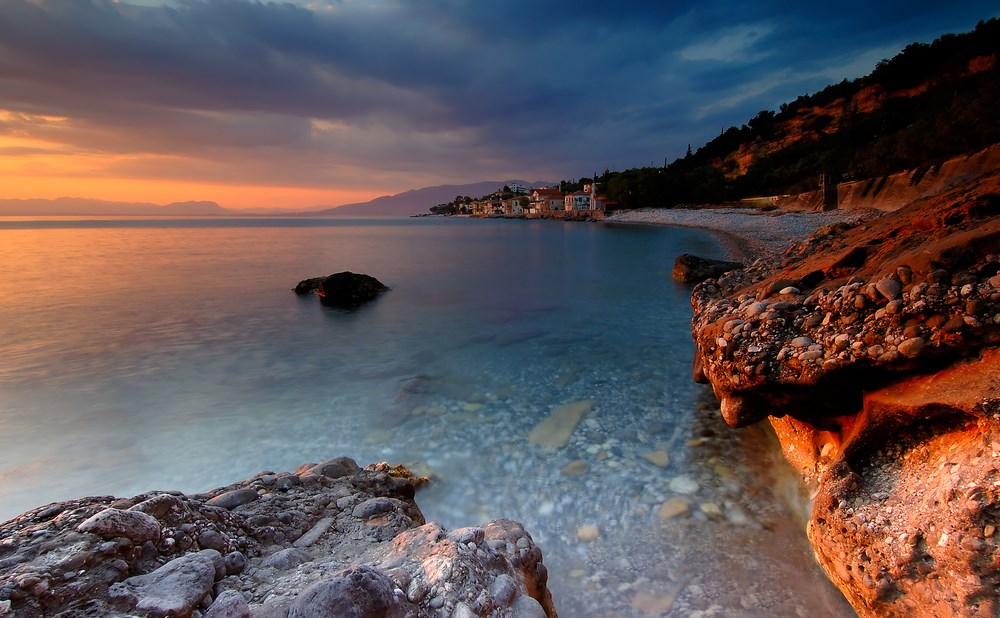
Olive groves running down to the Argolic Gulf. The lights of Spetses harbour catching the dusk. Stone houses tucked into the folds of the Arcadian mountains. The Peloponnese is the Greece you write home about — older, quieter, and more varied than any single island can offer. Add Spetses, the car-free island a short hop from the Peloponnese coast, and you have one trip with two distinct moods: mainland depth and island lightness.
This guide covers what makes the region different, when to go, what to do across four very different sub-regions, and our five hand-picked villas in the region.
Why the Peloponnese & Spetses
The Peloponnese is the southern peninsula of mainland Greece — connected to the rest of the country by a narrow strip of land at Corinth, but feeling, in many places, more like a continent than a region. You can drive from a Mycenaean ruin to a swimming beach to a mountain village in a single afternoon. There are no ferries to plan around. Distances may be short, yet each route reveals a gentle shift in scenery, offering a subtly different atmosphere from one place to the next.
Spetses sits just off the Argolic coast, reached in 15 minutes by water taxi from the small mainland port of Kosta (or directly from Piraeus, around 2 hours by ferry). Cars are banned beyond a small zone, so the island moves at the pace of horse-drawn carriages, scooters, and bicycles. It’s quieter than Hydra, more polished than Poros, and a destination in its own right — pair it with a Peloponnese leg or stay a full week.
Together, the two are the antidote to the busier Greek-island circuit. Fewer cruise crowds, more Greek food, and a much wider spread of what a holiday can look like: archaeology, hiking, beaches, monasteries, mountain skiing in winter, and the sort of pine-and-sea coastline that Tuscany would charge triple for.
When to go
The shoulder seasons are the quiet luxury of the Peloponnese.
May and June bring wildflowers across Arcadia, swimmable seas from late May, and significantly lighter traffic at Mycenae and Epidaurus. Daytime temperatures sit comfortably in the mid-20s; evenings still call for a light layer in the mountains.
July and August are the peak months, when the Argolic and Messinian beaches fill up and Spetses harbour hums with day-trippers from Athens. The mainland coast can climb past 35 °C; head inland to Arcadia, where the elevation drops the temperature by five or more degrees and the pine forests do the rest.
September and October are arguably the region’s finest months. The sea is at its warmest, the harvest is on (olives in October, grapes earlier), and the village squares belong to locals again. Days are long enough for an early morning at Mycenae, lunch in Nafplio, and a swim before sunset.
November to April is mostly closed for sea-and-pool holidays, but Arcadia and Kalavrita come into their own — open fireplaces, snow on Mainalon, the rack railway running through frost-bound gorges, ski runs above the monasteries, and Villa Mainalis’s outdoor heated jacuzzi to come back to.
What to do, by sub-region
The Peloponnese is too varied to reduce to a single itinerary. Here’s how the four sub-regions where we keep villas differ from one another, and what’s worth doing in each.
Nafplio and the Argolic coast
Nafplio is the most photographed small town in the Peloponnese, and deservedly so: a Venetian harbour, a fortified island in the bay, and a hilltop fortress (Palamidi — 999 steps if you’re counting) reached on foot or by car. The old town is car-free in the evenings; locals and visitors fill the marble streets and the seafront tavernas.
Within an hour’s drive sit two of Greece’s most important archaeological sites: Mycenae, the citadel of Agamemnon, and Epidaurus, whose ancient theatre still hosts performances in summer with acoustics so good that a coin dropped on the stage can be heard from the top row. Both are UNESCO-listed.
For beaches, the local picks are Karathona (a 30-minute walk from Nafplio along the coast), Tolo, and Plaka further south.
Spetses Island
The old harbour and the Dapia (the cannon-lined main square) are the heart of Spetses. There are no cars in town — getting around is by horse-drawn carriage, scooter, bike, or water taxi to a quieter cove. The whole island is rideable in a half-day at moderate effort.
The Bouboulina Museum tells the island’s outsized role in the 1821 War of Independence, and the Anargyrios & Korgialenios School — the building that inspired John Fowles’s The Magus — sits among the pines above town. Beach-wise, Agia Marina is the easiest from the harbour, Anargyri the prettiest, and Vrelos the locals’ favourite for late-afternoon swims.
Arcadia and the Menalon mountains
Arcadia is the green, mountainous interior — pine and chestnut forests, stone villages, monasteries clinging to gorge walls. The two villages most travellers fall for are Stemnitsa (silversmiths, slate roofs, a walk-in working bell foundry) and Dimitsana (perched above the Lousios Gorge, with the best view in the region).
Between them runs the Menalon Trail, a 75 km waymarked hike through the gorge that you can sample in 2–3 hour day-walks rather than tackling end-to-end. The summer heat in mainland Greece doesn’t reach up here; the hiking season is May to October.
For a slower day, drive to Vytina, a mountain town surrounded by walnut groves where the cafés are built around the village square’s enormous plane trees.
Kalavrita and the Vouraikos Gorge
Kalavrita’s most-loved experience is the Odontotos rack railway — a 22 km climb from the coast at Diakopto up through the Vouraikos Gorge, with the train pulling itself up some of the gradient by means of a toothed central rail. It runs daily; you can ride one way and walk back along the gorge floor through a series of tunnels.
The Cave of the Lakes sits above the town: a series of underground lakes connected by a horizontal cave system, walkable on a wooden boardwalk. The Mega Spilaio monastery, built into a sheer cliff face, is the kind of thing photographs don’t quite explain.
In winter, the Kalavrita ski centre is one of the better-equipped in southern Greece — runs at 1,700 m, a 20-minute drive from the town.
Where to stay — our hand-picked villas
We keep five villas in the Peloponnese & Spetses, each chosen for a different kind of stay.
Villa Aelia — Spetses Island. An elegant, newly built stone house tucked into a quiet residential pocket of Spetses where motorbikes aren’t permitted — rare on this scooter-loving island. The setting is the strength: two minutes’ walk to Agios Mamas beach, three to the old harbour and the Dapia (the cannon-lined main square), but on a hushed lane that lets you escape the harbour buzz at the end of the day. Sleeps small groups in comfort; well-suited to week-long stays or long weekends. Walking-distance access to the harbour tavernas means car-free evenings, and water taxis can drop you at any cove on the island in under fifteen minutes.
Villa Kivis — Kiveri, near Nafplio. A three-bedroom stone house built into the hillside above the Argolic Gulf, with sea views from the pool, the terraces, and most of the rooms. The 40-square-metre pool is its most-used feature — a generous size by villa standards — and the outdoor barbecue is the right tool for a Greek-style late dinner under the stars. Interior is modern, light-filled and fully air-conditioned. The classic Peloponnese base: an hour to Mycenae and Epidaurus, twenty minutes into Nafplio’s old town for an evening, and fifteen to a swimmable beach. The villa for couples or a small family who want both relaxation and easy day-trip access to world-heritage sites.
Villa Mainalis — Menalon, Arcadia. A stylish stone-built chalet on the slopes of Mount Mainalon, in the small Arcadian village of Neos Kardaras. Newly upgraded for 2026 with a pool, an outdoor heated jacuzzi, and five bedrooms sleeping up to twelve. The mountain villa for groups — wood-burning stove, walking trails from the door, cool nights even in August. The location is Mainalis’s most surprising feature: just 10 minutes from the Mainalon ski centre (a 10 km drive), 30 minutes from the mountain village of Vytina, an hour from the beaches near Nafplio, and 1.5 hours from Athens airport. Lonely Planet named the Peloponnese its number-one destination of 2016 — Mainalis sits at the centre of the reasons why. Suits multi-generation family stays, group reunions, and travellers combining mountain and sea in one trip.
Villa Serenis — Porovitsa, near Kalavrita. Up on a hillside above the village, with sea-and-mountain views from every direction — the pool terrace looks one way to the Gulf, the other to the slopes above Kalavrita. Privacy and peacefulness are its defining features: no neighbours within sight, the only sound the cicadas at dusk. Practical proximity is the underrated other strength: 15 minutes from a crystal-clear swimming beach, an hour to the Kalavrita ski centre, 15 minutes to Lake Tsivlos and the Vouraikos Gorge, and 2.5 hours to Delphi for a long day-trip. Suits travellers who want a mountain-and-sea split in one base.
If you’d like a hand matching dates, group size, and the kind of holiday you have in mind to the right villa, send us your dates and we’ll come back with two or three options that fit.
Practical: Peloponnese & Spetses, need to know
| Nearest airport | Athens International (ATH) |
| Drive from Athens | 1.5 hr (Nafplio), 2 hr (Kosta for Spetses ferry), 3 hr (Arcadia / Kalavrita) |
| Ferry to Spetses | 15 min from Kosta, 2.5 hr from Piraeus (Athens) |
| Best months | May–June, September–October (peak July–August) |
| Car needed | Yes for the mainland; not on Spetses |
| Currency | Euro (€) |
| Language | Greek; English widely spoken in tourism |
| Time zone | EET (UTC+2 / UTC+3 in summer) |
FAQ
When is the best time to visit the Peloponnese?
May, June, September, and October. The sea is swimmable, daytime temperatures sit in the mid-20s to high-20s °C, and the major sites (Mycenae, Epidaurus, Olympia) are far quieter than in peak summer. July and August are the warmest and busiest months — though our mountain villas (Villa Mainalis in Arcadia, Villa Serenis near Kalavrita) sit several degrees cooler at altitude, which makes them comfortable summer bases too.
Do you need a car on Spetses?
No. Cars are not permitted in most of the island, and the town is walkable end to end. Get around by foot, bicycle, scooter, horse-drawn carriage, or water taxi to a beach. If you’re staying on the Peloponnese mainland, a hire car is essential.
How far is the Peloponnese from Athens airport?
A 1.5-hour drive to Nafplio, around 2 hours to Kosta (the port for Spetses), and 2.5–3 hours to the Arcadian villages or Kalavrita. The new Athens–Patras motorway has cut journey times in recent years.
Are these villas family-friendly?
Yes. Villa Mainalis sleeps 12 across five bedrooms, has a wooden outdoor playground, and is the most popular option for multi-generation family stays; Villa Kivis works well for families wanting an Argolic coast base; Villa Serenis suits families who like the idea of a mountain-and-sea split. All five villas come with cots, high-chairs, and child-friendly equipment as standard.
Looking at another region of Greece? Browse all hand-picked villas across Greece. Region guides for the Cyclades, Pelion, and Attica, Evia & Chalkida are coming soon.
